1. Overview
Orihime Inoue is a high school student from Karakura Town and one of Ichigo Kurosaki's closest friends. She is a spiritually aware human who develops extraordinary powers through the six hairpins she wears, which manifest as fairies called the Shun Shun Rikka (Six Flowers of the Shield Maiden). Unlike Soul Reapers who fight with zanpakuto or Quincies who manipulate reishi, Orihime's ability is fundamentally unique: she can reject phenomena, effectively overwriting reality to undo damage that has already occurred. Her power operates on a level that even the most advanced Soul Reapers, including Sosuke Aizen, cannot fully comprehend. Aizen targeted Orihime because he believed her ability could reject the Hogyoku's evolution, making her a threat to his plans. Orihime's journey throughout Bleach is one of emotional growth and self-empowerment. She begins the series as a kind-hearted but somewhat passive girl who relies on others for protection and gradually transforms into a woman who stands on her own, confident in her abilities and her right to fight alongside her friends. Her older brother Sora Inoue died protecting her when she was young, an event that shaped her gentle personality and her deep appreciation for the value of life. She lives alone in a small apartment, working part-time at a local bakery and attending Karakura High School, where her boundless optimism and unusual way of thinking make her both beloved and baffling to her classmates.
2. Appearance
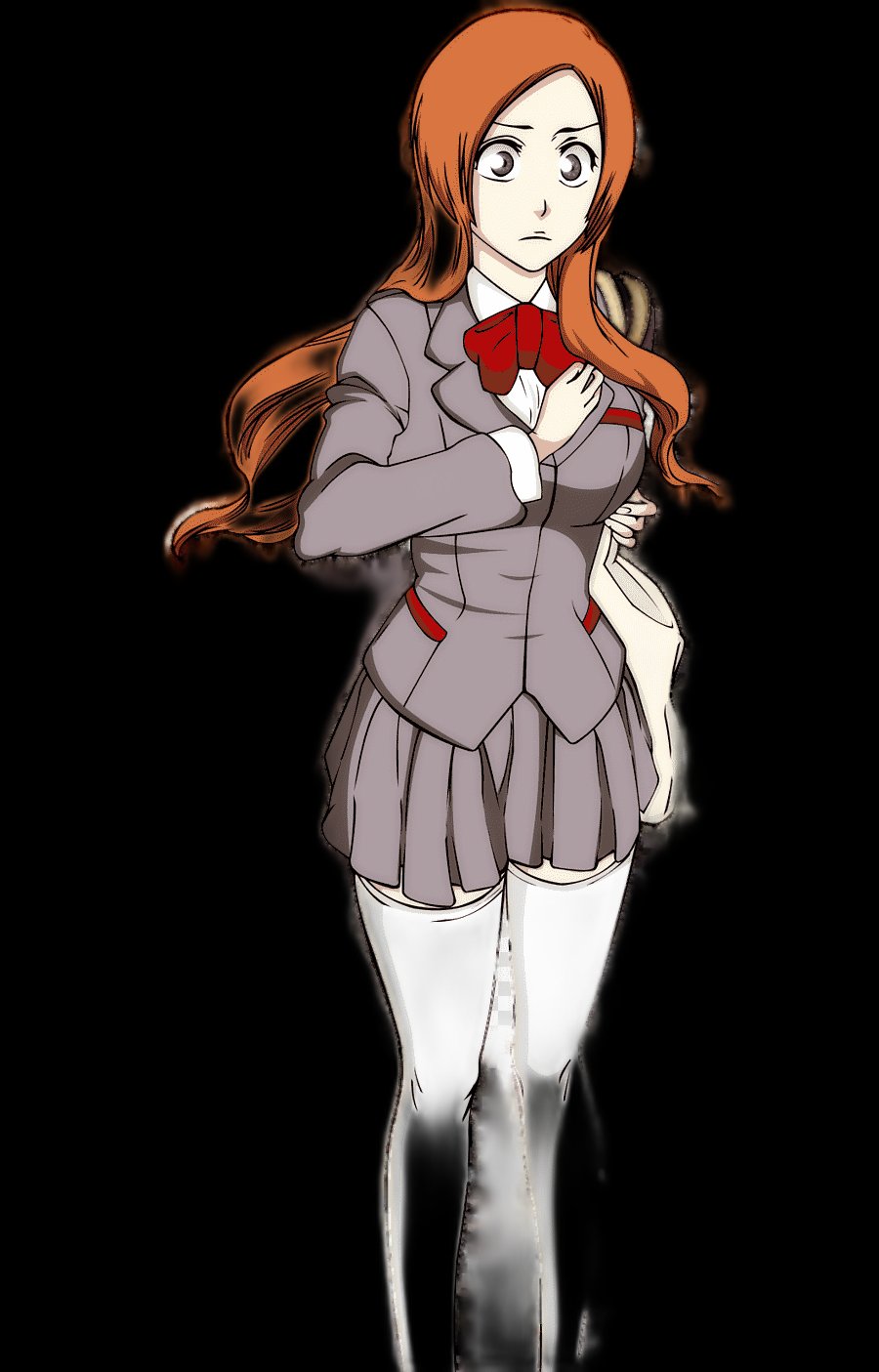
Orihime Inoue is a young woman of average height with a slender build and a warm, approachable presence that draws people to her naturally. Her most distinctive features are her long, vibrant orange hair that falls past her waist and her large, expressive brown eyes. Her hair is held back by six distinctive hairpins shaped like six-petaled flowers, which are not ordinary accessories but the physical vessels for her Shun Shun Rikka abilities. These hairpins are the source of her power, and without them, she cannot summon her fairies. She typically wears the standard Karakura High School uniform: a white button-up shirt with a red ribbon tied at the collar, a navy blue pleated skirt, and brown loafers. When not in school uniform, Orihime favors feminine, cheerful clothing that reflects her optimistic personality, often choosing pastel colors and floral patterns. Unlike many anime heroines who rely on revealing outfits to define their character design, Orihime's clothing consistently emphasizes her warmth and approachability.
When Orihime activates her Shun Shun Rikka abilities, her appearance does not change dramatically like a Soul Reaper's does when releasing Bankai. Instead, the six fairies emerge from her hairpins, each with a distinct appearance and personality. Tsubaki is the red fairy with a ponytail who handles offensive attacks. Ayame is the blue fairy with twin tails. Shun'o is the purple fairy with a gentle demeanor. Hinagiku is the white fairy with a calm presence. Lily is the yellow fairy with a cheerful personality. Baigon is the green fairy who is the largest and most protective. These fairies orbit around Orihime when summoned, creating a golden energy field around her body. During the Arrancar arc, Orihime briefly adopts a new outfit provided by the Soul Society: a white combat uniform designed for her mission in Hueco Mundo, though it is functionally identical to her normal clothes regarding protective capability. After the timeskip following the Thousand-Year Blood War, Orihime appears in the epilogue with her hair in a more mature style, wearing a longer skirt and a ring on her left hand, indicating her marriage to Ichigo Kurosaki.
3. Personality
Orihime Inoue is defined by her extraordinary capacity for kindness and her unwavering optimism in the face of adversity. She possesses a gentle heart that extends compassion to everyone she meets, including her enemies. When confronted with violent opponents, Orihime's first instinct is not to retaliate but to understand why they are fighting and whether there is a way to resolve the conflict without bloodshed. This pacifist nature is not born from weakness but from a profound respect for the value of all life, a value forged through the tragedy of losing her brother. She has a childlike wonder about the world that manifests in her love for cute things, her habit of giving nicknames to everything, and her tendency to imagine conversations with animals and inanimate objects. Her cooking is infamously terrible, producing dishes with bizarre color combinations and flavors that defy culinary logic, yet she never stops experimenting. Her academic performance is inconsistent: she excels in subjects that spark her imagination but struggles with practical, logic-based disciplines. She thinks in metaphors and emotional connections rather than rational frameworks, which makes her difficult for conventional teachers to understand.
Beneath Orihime's cheerful exterior lies an immense emotional strength that has been tested repeatedly throughout the series. When her brother Sora returned as a Hollow and she had to accept that the entity attacking her was no longer the person she loved, she showed the maturity to let go. When she was taken to Hueco Mundo by Ulquiorra Cifer and manipulated by Aizen, she endured psychological torture without breaking. When she was forced to watch Ichigo's brutal fight against Ulquiorra, she found the courage to heal him and support him despite her fear. Orihime's greatest strength is her refusal to give up on people. She sees the good in everyone, including her enemies, and this faith in humanity often inspires others to live up to her expectations. Her catchphrase about wanting to protect the people she cares about is not empty sentiment: she trains diligently, develops her abilities, and consistently puts herself in danger to support her friends. Her emotional intelligence is her most underrated quality: she can read the emotions of those around her with remarkable accuracy, often understanding what someone needs to hear before they know it themselves. This sensitivity makes her the emotional anchor of the Karakura Town group, the person others turn to for comfort and understanding.
4. Abilities & Powers
Orihime's power, Shun Shun Rikka, manifests as six fairies that emerge from her hairpins. Each fairy has a distinct name, color, and personality: Tsubaki (attack), Ayame, Shun'o, Hinagiku, Lily, and Baigon (defense and healing). The fundamental principle of Shun Shun Rikka is the rejection of phenomena, a power that allows Orihime to deny events that have already occurred and overwrite them with a preferred reality. This is not healing in the conventional sense but a form of retroactive reality manipulation. Her primary defensive technique is Santen Kesshun (Three Shields' Defensive Circle), which creates a triangular barrier of light formed by three of her fairies. This barrier can block attacks of tremendous power, though it has limits and can be overwhelmed by sufficiently strong opponents. Her true defensive power lies in the shield's ability to reject the phenomenon of an attack entirely, effectively erasing the damage before it occurs. She uses this barrier to protect herself and her allies, and it has proven capable of blocking attacks from captain-level opponents, though sustained assault can break through it.
Orihime's offensive technique is Koten Zanshun (Single Shield's Cutting Edge), which manifests as a single fairy, Tsubaki, who transforms into a blade of pure energy that can cut through virtually anything. Unlike her defensive and healing abilities, this technique rejects the phenomenon of the target's existence, effectively severing the connection between an object and its physical form. However, Tsubaki can be damaged or destroyed if the target has sufficiently strong spiritual pressure, and Orihime hesitates to use this ability against living opponents because she finds the concept of a killing weapon disturbing. Her most famous and powerful ability is Soten Kisshun (Twin Shields' Healing Embrace), which creates a barrier formed by two fairies that converges on a target and heals them by rejecting the phenomenon of damage. This ability can heal wounds that would be fatal to ordinary humans and Soul Reapers alike, including the complete regeneration of lost limbs and the restoration of near-fatal injuries. Sosuke Aizen coveted this ability because he believed it could reject the Hogyoku's evolution, effectively reversing his transformation. With significantly more power, Orihime could theoretically reject the phenomenon of death itself. She also has the ability to reject phenomena on a larger scale, shown when she restores the barrier between the living world and Hueco Mundo after Aizen's defeat.
5. Story Arcs
Substitute Soul Reaper Arc. Orihime is introduced as a cheerful but slightly odd classmate of Ichigo's who notices something different about him after he gains Soul Reaper powers. Her older brother Sora, who died protecting her, returns as a Hollow called Acidwire. Orihime must accept that the monster attacking her is no longer her brother and allow Ichigo to defeat him. This traumatic event awakens her latent spiritual powers for the first time. She later develops her Shun Shun Rikka abilities with the help of Rukia Kuchiki, who teaches her the basics of spiritual combat and helps her understand the nature of her power. By the end of this arc, Orihime has accepted her role as a spiritually aware human and committed herself to supporting Ichigo and protecting Karakura Town.
Soul Society Arc. Orihime accompanies Ichigo, Uryu, and Sado on their mission to rescue Rukia from the Soul Society. She plays a critical support role, using Santen Kesshun to block attacks that would incapacitate her teammates and Soten Kisshun to heal injuries sustained in battle. Her fight against the 3rd Seat of the 11th Division demonstrates her growing courage and her commitment to the mission. When she encounters the 9th Division Lieutenant Shuuhei Hisagi, she holds her own through a combination of defensive power and quick thinking. Her most significant contribution is her unwavering emotional support for Ichigo, who draws strength from her presence even when she is not physically beside him. This arc establishes Orihime as a reliable member of the team, not just someone who needs to be protected.
Arrancar Arc. The Arrancar arc is Orihime's most character-defining storyline. Sosuke Aizen, recognizing the value of her rejection ability, manipulates events to lure her to Hueco Mundo. Ulquiorra Cifer captures her and brings her to Las Noches, where Aizen attempts to use her power to further his evolution. Orihime is subjected to psychological torment throughout her captivity, forced to watch her friends fight and suffer while being powerless to intervene. She refuses to heal the Hogyoku for Aizen, maintaining her integrity even under extreme pressure. Her emotional breakdown after Ichigo's near-fatal battle against Ulquiorra is one of the series' most powerful moments: she screams in despair, and her emotional turmoil awakens Ichigo's full Hollow transformation. After Ichigo's victory, Orihime heals him and demonstrates that her power has grown through her emotional ordeal. She returns to Karakura Town with her friends, stronger and more confident in her abilities and her right to fight.
Fullbringer and Thousand-Year Blood War Arcs. During the Fullbringer arc, Orihime supports Ichigo as he loses and regains his Soul Reaper powers, demonstrating her complete loyalty even when Ichigo pushes his friends away. In the Thousand-Year Blood War arc, Orihime plays a vital support role in the war against the Wandenreich. She joins Ichigo in the Royal Palace training and participates in the final assault on Yhwach's fortress. In the climactic battle, Orihime's Soten Kisshun is used to protect Ichigo from Yhwach's attacks, and her rejection ability proves critical in countering the Almighty's future-manipulation. She survives the war and, in the epilogue set ten years later, has married Ichigo and has a son named Kazui Kurosaki. Her Shun Shun Rikka ability is shown to have been passed down genetically, as Kazui demonstrates similar powers. Orihime's journey from a grieving sister to a confident wife and mother is one of Bleach's most complete character arcs.
6. Relationship Network
Orihime's most significant relationship is with Ichigo Kurosaki, whom she has loved since before the series began. Her feelings for Ichigo are a persistent emotional undercurrent throughout the story, though her characteristic shyness and Ichigo's obliviousness prevent direct confession. Orihime's love for Ichigo is demonstrated through action rather than words: she rushes to heal him whenever he is injured, she follows him into danger without hesitation, and she draws emotional strength from his presence. In the epilogue, the two are married with a son, confirming that her feelings were reciprocated. Tatsuki Arisawa is Orihime's best friend and protector before Ichigo enters her life. Tatsuki is a skilled martial artist who has known Orihime since childhood and has always looked out for her. Their friendship remains strong throughout the series, with Tatsuki representing Orihime's connection to her normal human life. Rukia Kuchiki and Orihime develop a close friendship over the course of the series, beginning as acquaintances who share a connection to Ichigo and growing into genuine friends who respect and support each other.
Uryu Ishida and Yasutora Sado are Orihime's classmates and fellow members of the Karakura Town group. She shares a warm, sibling-like bond with both of them, often acting as the emotional mediator when the group's dynamics become tense. Sora Inoue, her deceased older brother, is the single most influential figure in Orihime's life. He sacrificed himself to protect her from a Hollow attack, and his death shaped her gentle personality and her fierce determination to never let anyone else die for her sake. Her return as a Hollow forced Orihime to confront the harsh reality of the spiritual world and accept that the boundaries between life and death are more fluid than she once believed. Sosuke Aizen's relationship with Orihime is manipulative and predatory. He targeted her because her rejection ability posed a threat to his Hogyoku evolution. She represents the one power he could not control or replicate. Ulquiorra Cifer, her captor in Hueco Mundo, develops a complex fascination with the human heart through his interactions with Orihime, questioning his own nature as a Hollow before his death. The Shun Shun Rikka fairies themselves are Orihime's constant companions, each with a distinct personality that reflects different aspects of her character. Tsubaki's aggression, Lily's cheerfulness, and Baigon's protectiveness all represent facets of Orihime's emotional world.
7. Cultural Impact & Popularity
Orihime Inoue occupies a distinctive position in the Bleach fanbase as a widely discussed and beloved character. She consistently ranks in the top five of official female character popularity polls within the Bleach franchise, and her relationship with Ichigo has been a subject of intense fan discussion for over two decades. Her character design, created by Tite Kubo, is notable for its emphasis on elegance and warmth rather than the exaggerated sexuality common in female shonen character designs of the era. Kubo has stated that Orihime was designed to be the emotional heart of the series, the character who reminds everyone what they are fighting for. Her orange hair, like Ichigo's, was chosen to make her stand out visually and to create a visual connection between the two characters. The Shun Shun Rikka fairies, each with a distinct design and personality, have become iconic symbols of Orihime's character, frequently featured in merchandise and fan art. Orihime's theme music, composed by Shiro Sagisu, is gentle and melancholic, reflecting the sadness beneath her cheerful surface. Her voice actresses have received significant acclaim: Yuki Matsuoka in Japanese captures Orihime's gentle warmth and emotional vulnerability, while Stephanie Sheh's English performance brings a layer of depth and maturity to the role.
In fan communities, Orihime's character arc is frequently discussed in debates about female character development in shonen manga. Critics of her early portrayal argue that she is reduced to a damsel-in-distress role during the Hueco Mundo arc, while defenders point out that her emotional strength and refusal to betray her friends while in captivity demonstrate genuine heroism. Her statement to Ulquiorra about no longer wanting to be protected and instead wanting to protect others is cited as a turning point for her character. Academic analyses have examined Orihime as a subversion of the traditional healer archetype, noting that her ability to reject phenomena ranks among the most conceptually powerful in the series, limited only by her pacifist nature. Her relationship with Ichigo, culminating in their marriage and child in the epilogue, has been praised as one of the more natural and earned romantic conclusions in shonen manga. Orihime appears in nearly every Bleach video game, typically as a playable healer character with unique support abilities. Her character has been featured in extensive merchandise lines, from detailed action figures to affordable keychains, and her hairpins have become a popular convention accessory. In the wider anime community, Orihime represents a specific type of female character whose kindness is presented not as weakness but as the most powerful force in the story.
8. FAQ
What is Orihime's power and how does it work?
Orihime's power is called Shun Shun Rikka (Six Flowers of the Shield Maiden), manifested through six fairies from her hairpins. The ability allows her to reject phenomena, effectively overwriting reality to undo damage. She has three techniques: Santen Kesshun (defensive barrier), Koten Zanshun (offensive cutting), and Soten Kisshun (healing by rejecting damage).
Do Ichigo and Orihime end up together?
Yes, Ichigo and Orihime marry and have a son named Kazui Kurosaki, as shown in the epilogue set ten years after the Thousand-Year Blood War. Their relationship develops subtly throughout the series, with Orihime's feelings being more apparent, and the final chapter confirms their marriage through Orihime's ring and their shared household.
Why did Aizen want Orihime's power?
Aizen wanted Orihime because her rejection ability could theoretically negate the evolution of the Hogyoku, making her one of the few beings capable of reversing his transformation. He captured her during the Arrancar arc and attempted to use her power for his own purposes, but Orihime refused to cooperate, maintaining her integrity even under extreme duress.
What happened to Orihime's brother?
Orihime's older brother Sora Inoue died protecting her from a Hollow attack when she was young. His spirit later returned as the Hollow Acidwire during the Substitute Soul Reaper arc. Orihime had to accept that the monster was no longer her brother and allow Ichigo to defeat him, an event that awakened her latent spiritual powers.
Can Orihime heal any injury?
Orihime's Soten Kisshun can heal wounds that would be fatal to normal humans and Soul Reapers, including complete limb regeneration. However, her power has limits. She cannot heal herself, and sufficiently powerful spiritual attacks can overwhelm her healing barrier. Aizen believed that with more power, Orihime could potentially reject the phenomenon of death itself, though this remains theoretical.