1. Overview
Ulquiorra Cifer is the Cuatro Espada, the fourth-ranked Arrancar in Sosuke Aizen's army, and a very enigmatic and philosophically complex antagonists in Tite Kubo's Bleach. He serves as Aizen's most trusted operative, frequently handling critical missions such as reconnaissance on the Human World and the capture of Orihime Inoue. Ulquiorra is defined by his absolute nihilism: he genuinely believes that the heart, the concept of emotions and human connection, is a meaningless illusion. His worldview is built on the belief that emptiness is the natural and correct state of existence, and that all beings are fundamentally alone. This nihilistic philosophy is not a facade or a coping mechanism but a deeply held conviction that shapes every aspect of his behavior, speech, and combat approach. Unlike many of the other Espada, who are driven by ambition, sadism, or a desire for approval, Ulquiorra fights with cold, detached efficiency, showing no joy in victory and no frustration in defeat. His role in the story places him directly opposite Ichigo Kurosaki and Orihime Inoue, and his interactions with them gradually challenge his core beliefs. The character's name deliberately references Lucifer, the fallen angel, and his design and abilities evoke demonic and bat-like imagery that reinforces this connection. Ulquiorra is unique among the Espada for possessing the ability to achieve a second stage of Ressureccion, Segunda Etapa, a power that surpasses even the Primera Espada's capabilities. His battle against Ichigo in Hueco Mundo is a very famous fights in the entire Bleach series, culminating in a moment of emotional awakening that transforms his nihilistic worldview moments before his death.
2. Appearance
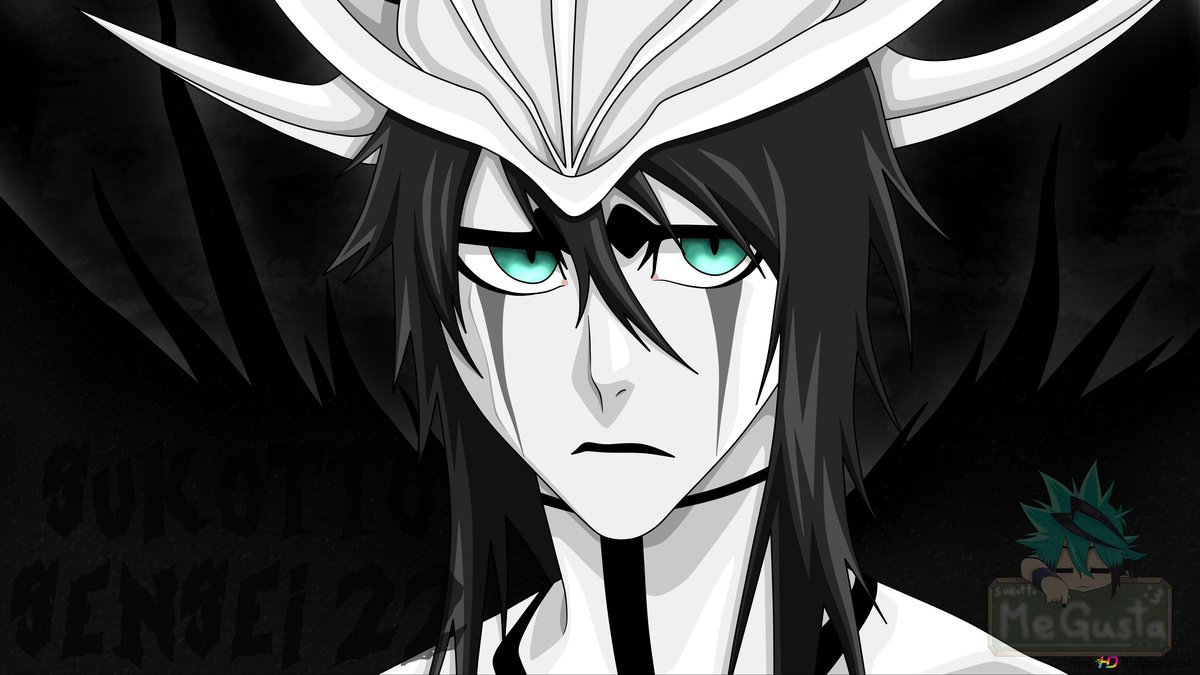
Ulquiorra Cifer has a striking and memorable appearance that sets him apart from the other Espada. He has pale, porcelain-like skin, short black hair that is slightly spiky, and distinctive green eyes with slit pupils that give him a reptilian, inhuman quality. The most prominent feature on his face is the dark green markings that run from his eyes down his cheeks, resembling tear tracks, a visual representation of the sadness and emptiness that defines his worldview. These markings are unique among Arrancars and contribute to his melancholic aesthetic. He wears the standard white Arrancar uniform consisting of a long white coat over a black inner shirt and white hakama, but he wears it with a distinctive sash and carries himself with an air of cold dignity. Unlike many Arrancars who leave their hollow hole in a location corresponding to their original Hollow form, Ulquiorra's hollow hole is located in the center of his chest, clearly visible through the opening in his uniform. His zanpakuto, Murcielago, takes the form of a standard Arrancar blade before release, worn at his waist.
Ulquiorra's appearance changes dramatically when he releases his Resurreccion. In his first release state, black energy envelops his body and transforms him into a bat-like demon. He grows large, black, leathery wings with a skeletal structure, his body is covered in black markings, and he gains a long, whip-like tail. His face remains visible but is framed by the dark energy of his release. His Segunda Etapa, the second release unique to him among all Espada, takes this transformation even further. In this state, Ulquiorra's appearance becomes truly demonic: his wings transform into immense, horned bat wings, a single horn grows from his forehead, his lower body becomes shrouded in dark energy, and he gains a massive horned demonic energy projection around his actual body. His green eyes become bloodshot, and his entire form emanates a terrifying spiritual pressure that can be felt across the entirety of Hueco Mundo. The Segunda Etapa form visually represents Ulquiorra's descent into pure, unadulterated nihilistic power, a being that has shed all pretense of humanity.
3. Personality
Ulquiorra Cifer is defined by an absolute lack of emotion and a deeply philosophical nihilism. He speaks in a flat, monotone voice and approaches every situation with cold, logical analysis. He expresses no joy, anger, sadness, or fear, even in the face of death or victory. This emotional void is not a repression of feelings but a genuine absence: Ulquiorra simply does not experience emotions and cannot comprehend why others do. His worldview is summed up in his repeated assertion that the heart is meaningless, that what humans call emotions are merely biological responses that serve no real purpose. He is genuinely curious about humans, particularly Orihime Inoue, whose emotional nature he finds both fascinating and incomprehensible. Ulquiorra's interactions with Orihime form the core of his character development. He is assigned to watch over her during her captivity in Las Noches, and her kindness, hope, and emotional resilience confuse him. He repeatedly tests her beliefs, trying to break her spirit and prove that her emotions are illusions. Yet her refusal to despair forces him to confront questions about his own nature that he cannot answer.
Ulquiorra possesses a strange kind of honor. He does not enjoy killing or causing pain for its own sake. He fights because he is ordered to, and he kills because he sees it as the logical conclusion of conflict. He treats Orihime with respect and courtesy during her captivity, providing her with comfortable quarters and not mistreating her. Even in battle against Ichigo, Ulquiorra displays no malice. He is simply executing his mission. This detached approach makes him more terrifying than any sadistic villain because there is no reasoning with him, no emotion to exploit. His worldview is challenged most profoundly by Orihime's declaration that the heart exists because she can feel it and by Ichigo's refusal to stay down despite being defeated multiple times. The moment before his death, when Ulquiorra asks Orihime what she is afraid of and shows the first signs of understanding emotion, is a very poignant moments in Bleach. His final words, asking if the heart exists and if he was able to understand it before his body dissolves into dust, transform him from a cold monster into a tragic figure who spent his existence searching for something he could never name.
4. Abilities & Powers
Ulquiorra is a very powerful Arrancars in existence, possessing immense spiritual pressure, incredible speed, and a unique ability to achieve a second Resurreccion stage that no other Espada can match. His base form is already formidable, with the ability to fire Cero from his fingertip and move at speeds that surpass most Soul Reapers' perception. He is a master of close-quarters combat, using his zanpakuto with precision and power, but his true strength lies in his Arrancer abilities. His signature technique is Cero Oscuras, a black Cero that he fires from his hand or from the tip of his horn. This technique is far more powerful than a standard Cero, described as being the equivalent of a Cero fired by a vast multitude of Hollows combined. He demonstrates this technique by overpowering Ichigo's Getsuga Tensho with contemptuous ease. His zanpakuto, Murcielago, releases into a bat-themed form that enhances his speed, strength, and gives him wings for aerial combat.
Ulquiorra's most devastating attack in his first release is the Lanza del Relampago (Lance of Lightning). This technique manifests as a massive, javelin-like spear of green energy that he hurls at his opponent with devastating force. The Lanza del Relampago has such immense power that when Ulquiorra throws it, the shockwave alone can level entire sections of Las Noches, the massive fortress of Hueco Mundo. The spear can also be detonated remotely, creating an explosion that dwarfs anything else in the Arrancar's arsenal. However, Ulquiorra admits that the Lanza del Relampago is difficult to control precisely, and his throws are not always accurate. The technique's sheer destructive power makes it a weapon of mass destruction rather than a precision tool.
Ulquiorra's most remarkable ability is his Segunda Etapa, a second stage of Resurreccion that no other Espada has achieved. According to Ulquiorra, the Espada's standard Resurreccion is not their true form but merely a sealed state. Segunda Etapa is the complete release of an Arrancar's power. In this form, Ulquiorra's abilities increase exponentially. He gains the ability to regenerate limbs almost instantly, his Cero Oscuras becomes powerful enough to create a crater the size of a stadium, and his speed reaches levels that Ichigo's Bankai-enhanced perception cannot track. The Segunda Etapa also grants Ulquiorra enhanced Hierro, the Arrancar's natural armor, making him virtually impervious to most attacks. In this state, he defeats Ichigo's Hollowfied Bankai form with ease, impaling him and blowing a hole through his chest. The only thing that can match Ulquiorra's Segunda Etapa is Ichigo's full Hollow transformation, triggered by despair at Ulquiorra's overwhelming power. This full Hollow form, with its white Hollow mask and black Hollow markings, represents Ichigo's complete loss of control and is the only force in the series that surpasses Ulquiorra's second release. Ulquiorra's regeneration ability in Segunda Etapa is particularly notable: even after having his arm blown off and his torso pierced, he can regenerate fully within moments, making him nearly impossible to kill through conventional means.
5. Story Arcs
Ulquiorra's story is almost entirely contained within the Arrancar arc, but his impact on the narrative and characters extends well beyond his death. He is first introduced alongside Yammy Llargo, the Décimo Espada, during a reconnaissance mission to Karakura Town. This early appearance establishes Ulquiorra as a cold, analytical figure who is more interested in observing Ichigo's abilities than in fighting him. He and Yammy report back to Aizen with their findings, setting the stage for the Arrancars' invasion. His second appearance involves the kidnapping of Orihime Inoue, a mission he carries out with cold efficiency. He incapacitates Ichigo and his friends, presents Orihime with Aizen's invitation to come to Hueco Mundo, and waits patiently for her decision. This sequence establishes the strange relationship between Ulquiorra and Orihime that will define his character arc.
The core of Ulquiorra's story is the Hueco Mundo invasion arc. He is assigned as Orihime's warden during her stay in Las Noches, guarding her in a tower while the other Espada fight the invading Soul Reapers. During this time, Ulquiorra engages in philosophical dialogues with Orihime, questioning her beliefs about the heart and emotions. He attempts to prove that her hope is meaningless by showing her the overwhelming power of the Espada and the futility of resistance. When Ichigo arrives to rescue Orihime, Ulquiorra intercepts him, viewing it as an opportunity to prove his nihilistic philosophy by crushing the hero's hope. Their first battle demonstrates Ulquiorra's overwhelming superiority. He defeats Ichigo's Bankai effortlessly, knocking him unconscious and leaving him in Orihime's care. When Ichigo recovers and fights again, Ulquiorra is forced to release his Resurreccion, and the battle escalates dramatically.
The final battle between Ulquiorra and Ichigo is a very famous in Bleach. After Ulquiorra releases his Segunda Etapa, he overwhelms Ichigo completely, impaling him and declaring that the concept of the heart is meaningless. Ichigo, seemingly dead, triggers his full Hollow transformation, becoming a berserk entity that attacks Ulquiorra with savage ferocity. The transformed Ichigo defeats Ulquiorra effortlessly, tearing off his arm and blasting a hole through his torso. Ulquiorra, in his dying moments, experiences something he has never felt before: he watches Orihime rush to Ichigo's side, desperate to save him, and he begins to understand what the heart truly means. His final act is to raise his hand toward Orihime and ask if she is afraid of his appearance, showing the first sign of genuine concern for another being. He dissolves into ash, having finally found the answer to his lifelong question in the moments of his death. This scene has become a very analyzed and emotionally impactful moments in the entire Bleach series.
6. Relationship Network
Ulquiorra's relationships are limited in number but profound in depth, largely because his nihilistic worldview prevents him from forming traditional bonds. The most significant relationship in his life is with Orihime Inoue. Assigned as her warden in Las Noches, Ulquiorra finds himself drawn to her inexplicable optimism and emotional resilience. He constantly tests her beliefs, trying to prove that her hope is an illusion. He asks her why she smiles when she is a prisoner, why she cares about others when she cannot save herself, and what she believes the heart really is. Orihime's simple, unshakeable faith in the power of emotions confuses and fascinates him. In his final moments, it is Orihime's compassion that awakens in him the first stirrings of emotional understanding. Their relationship is a very unique dynamics in Bleach: a nihilistic monster and an infinitely hopeful girl whose kindness , in the end, transcends his worldview.
Ulquiorra's relationship with Sosuke Aizen is one of master and servant. Unlike other Espada who scheme for power or approval, Ulquiorra serves Aizen with detached loyalty. He carries out orders without question, does not seek promotion or favor, and shows no fear or resentment toward his master. To Ulquiorra, Aizen is simply another being in an empty universe, and serving him is no different from not serving him. This absolute lack of ambition makes Ulquiorra uniquely trustworthy in Aizen's eyes. His relationship with the other Espada is distant. He does not form friendships or rivalries with his fellow Arrancars. He respects Grimmjow Jaegerjaquez as a competent fighter but has no emotional investment in their interactions. His cold demeanor and superior power make him respected but not liked among the Espada. Ulquiorra's relationship with Ichigo Kurosaki is the classic dynamic between nihilism and determination. Ulquiorra sees Ichigo as a test subject for his philosophy, a being whose hope and determination he wants to crush to prove that the heart is meaningless. When Ichigo refuses to stay defeated, Ulquiorra is forced to confront the limits of his own worldview. Ichigo's refusal to give up, even in the face of impossible odds, represents everything Ulquiorra cannot understand about the human spirit.
7. Cultural Impact & Popularity
Ulquiorra Cifer has become a very iconic villains in anime history, consistently ranking as one of the top favorite characters in Bleach worldwide popularity polls. His unique design, featuring the tear-track markings, green eyes, and pale skin, has become a very recognizable character designs in the series. The Segunda Etapa transformation, with its demonic wings and horned silhouette, is frequently cited as a very visually striking and terrifying transformations in shonen anime. Ulquiorra's nihilistic philosophy and his final scene of emotional awakening have been extensively analyzed in anime criticism as a masterful example of villain characterization. His famous line, "The heart is but an empty shell," and his final question, "Was this what you call a heart?" have become iconic quotes in the anime community, frequently referenced and parodied.
Ulquiorra's battle against Ichigo in the Hueco Mundo arc is consistently ranked among the top ten fights in Bleach and among the best anime battles of the 2000s decade. The animation of Ichigo's full Hollow transformation and Ulquiorra's Segunda Etapa clash has been praised for its fluid choreography, emotional weight, and visual spectacle. In Japanese, Hiroki Yasumoto's deep, monotone voice perfectly captures Ulquiorra's emotionless detachment, while in English, David Vincent's cold, measured delivery has been highly praised. Ulquiorra has appeared in all major Bleach video games, where his Segunda Etapa form is typically a very powerful unlockable characters. In Bleach: Brave Souls, his various versions, including the swimsuit and seasonal variants, are among the most sought-after characters in the game's gacha system. Ulquiorra's influence extends beyond Bleach itself. His character archetype the emotionless, philosophically nihilistic villain who finds redemption through death has been emulated in numerous subsequent series. His tragic ending, where he achieves emotional understanding only in his final moments, has been cited as an influence on character writing in later anime and manga. Ulquiorra's popularity has endured long after Bleach's conclusion, and he remains a very discussed and debated characters from the series, with fans continuing to analyze his philosophy, his relationship with Orihime, and the meaning of his final transformation.
8. FAQ
What is Ulquiorra's Segunda Etapa and why is it unique?
Segunda Etapa is a second Resurreccion stage that Ulquiorra can achieve beyond the standard Arrancar release. It is unique among all Espada; no other Espada has demonstrated this ability. In this form, Ulquiorra gains immense power, regeneration, and a demonic appearance. He states that the standard Resurreccion is a sealed state and Segunda Etapa is the true form.
What happens to Ulquiorra at the end of his fight with Ichigo?
After Ichigo's full Hollow transformation defeats him, Ulquiorra's body begins to disintegrate. In his dying moments, he watches Orihime rush to save Ichigo and experiences the first emotions of his existence. He raises his hand toward Orihime, asks if she is afraid, and dissolves into ash, having finally understood what the heart truly means.
Why is Ulquiorra ranked 4th if he is stronger than higher-ranked Espada?
The Espada are ranked 1 through 10 based on their power in their standard Resurreccion. Ulquiorra's Segunda Etapa is a hidden ability that Aizen did not account for when assigning ranks. His base power as the Cuatro Espada is accurate, but his Segunda Etapa surpasses even the Primera Espada Coyote Starrk's power level.
Does Ulquiorra develop feelings for Orihime?
Ulquiorra does not develop romantic feelings in a traditional sense. His interactions with Orihime challenge his nihilistic worldview and awaken in him the first understanding of emotions. He becomes curious about the concept of the heart and what makes humans care for each other. His final moments show him experiencing empathy for the first time.
What does Ulquiorra's name mean and why was it chosen?
Ulquiorra's name is derived from the Latin word for light and his surname Cifer is a reference to Lucifer, the fallen angel. This name choice reflects his role as a fallen, corrupted being and his demonic, bat-like appearance. The light-related reference contrasts ironically with his nihilistic worldview and his death in darkness.