1. Overview
Ichigo Kurosaki is the main protagonist of Tite Kubo's Bleach, a teenager from Karakura Town whose life changes forever when he inherits the powers of a Soul Reaper after meeting Rukia Kuchiki. Born to Isshin Kurosaki, formerly Captain Isshin Shiba of the 10th Division in the Gotei 13, and Masaki Kurosaki, a pure-blooded Quincy, Ichigo possesses a unique tri-racial heritage that forms the foundation of his extraordinary potential. His mother was saved from a Hollow attack by his father years before Ichigo's birth, and their union produced a child whose spiritual makeup defies the natural order separating Soul Reapers, Quincies, and Humans. The story begins when Rukia Kuchiki arrives in Karakura Town hunting a Hollow. Wounded in battle, she transfers her powers to Ichigo, thrusting him into the role of Substitute Soul Reaper. Throughout the series, Ichigo faces increasingly powerful enemies: Hollows in the Human World, the rogue Soul Reaper Sosuke Aizen and his army of Arrancars in Hueco Mundo, the mysterious Fullbringers who manipulate the souls of matter, and finally the ancient Quincy warlord Yhwach and his Sternritter during the Thousand-Year Blood War. Each conflict pushes Ichigo to new heights of power while forcing him to confront uncomfortable truths about his identity and the true nature of his zanpakuto. What sets Ichigo apart from other shonen protagonists is his unwavering sense of purpose: he does not fight for glory, recognition, or abstract ideals, but purely for the safety of those he loves.
2. Appearance
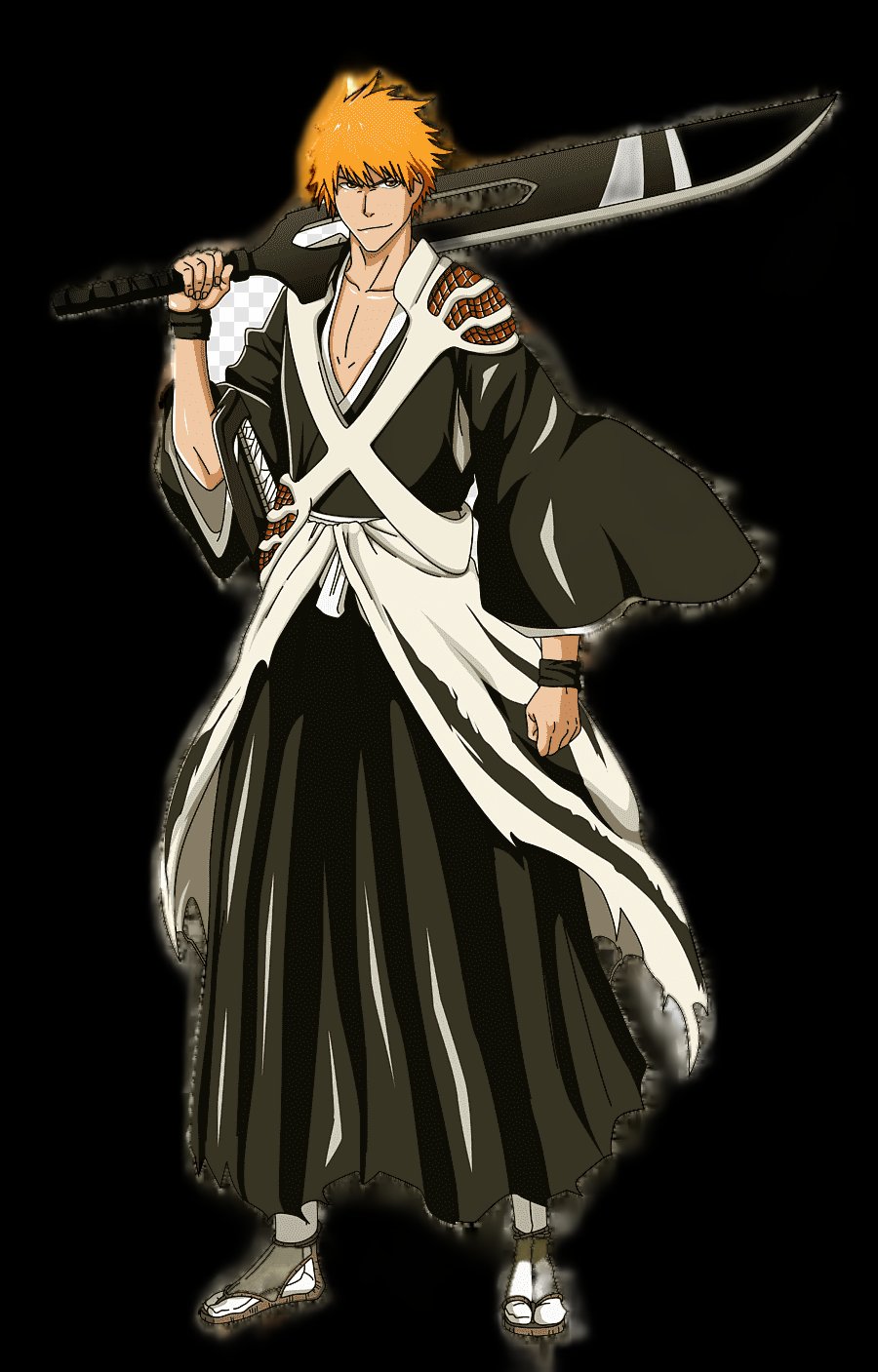
Ichigo Kurosaki is a tall, lean teenager standing approximately 181 centimeters with spiky orange hair inherited from his Quincy mother Masaki and sharp brown eyes. His orange hair is arguably his most recognizable feature, setting him apart in any crowd and often drawing comments from those he meets. In his daily life as a high school student, he wears the standard Karakura High School uniform: a white button-up shirt, dark trousers, and brown loafers, frequently accessorizing with a red-orange pendant necklace given to him by his mother before her death. When Ichigo assumes his Substitute Soul Reaper form, he dons the standard black shihakusho, a traditional long-sleeved robe consisting of a kosode inner garment and hakama wide-legged trousers worn by all members of the Gotei 13. Unlike most Soul Reapers who carry their zanpakuto at the waist, Ichigo slings his enormous blade Zangetsu across his back with a long white sash. In its sealed state, Zangetsu resembles an ordinary katana, but in Shikai it transforms into an oversized cleaver-like blade with a curved tip, no traditional tsuba guard, and a frayed white handle wrapping hanging from his right hand.
Ichigo's appearance undergoes dramatic changes with his various power forms. In Bankai Tensa Zangetsu, his shihakusho transforms into a form-fitting black longcoat with a floor-length skirt, and his zanpakuto compresses into a sleek thin black blade with a short chain connecting the hilt to the handle end. His Hollow mask appears as a white skull-like visor with red markings covering the left side of his face, featuring three red stripes on the left cheek and jagged teeth. During his Vizard training, Ichigo's Hollowfication progresses through several stages, from partial mask coverage to full Hollow transformation. The full Hollow form features a bone-white Hollow body with black markings across the torso and the ability to fire Cero energy blasts. In the Thousand-Year Blood War arc, Ichigo achieves the Horn of Salvation, manifesting as a single jagged horn on the right side of his head, representing the perfect fusion of his Shinigami, Hollow, and Quincy powers. His eyes in this form appear gold with slit pupils. His true Shikai after reforging Zangetsu by Nimaiya Oetsu consists of two blades: a larger black jagged blade representing his Hollow powers and a smaller white blade wrapped in cloth representing his Quincy powers.
3. Personality
Ichigo Kurosaki is defined above all by his fierce protectiveness toward those he cares about. He is deeply loyal to his family, including his father Isshin and his two younger sisters Karin and Yuzu, and to his friends, particularly Rukia Kuchiki, Orihime Inoue, Uryu Ishida, and Yasutora Sado. This protective instinct is so deeply ingrained that Ichigo routinely throws himself into life-threatening battles without hesitation if it means keeping someone else safe. His mother's death at the hands of the Hollow Grand Fisher when he was a child left a permanent scar on his psyche and forged his resolve to never let anyone else die on his watch. This trauma fundamentally shapes his worldview and explains why he reacts so violently when those close to him are threatened. Despite his hot-headed and impulsive exterior, Ichigo possesses a remarkably strong moral compass. He refuses to kill opponents who have shown honor or who he believes can be redeemed, even when doing so would make his own path easier. He respects worthy adversaries, from the Arrancar Grimmjow Jaegerjaquez, whom he acknowledges as a fellow warrior, to the Soul Reaper Kenpachi Zaraki, whose pure love of battle he understands. This sense of honor extends to his refusal to back down from any challenge, no matter how overwhelming the odds. When Sosuke Aizen effortlessly defeats him in their first encounter, Ichigo does not cower but trains relentlessly to close the gap. When the Sternritter invade the Soul Society, Ichigo stands against Yhwach despite knowing the Quincy king possesses power that defies comprehension.
Ichigo carries a heavy burden of responsibility and often internalizes his struggles, believing that showing weakness would endanger those who rely on him. This tendency to shoulder everything alone is both his greatest strength and his most significant flaw. He struggles with his inner Hollow, the entity White, throughout the series, a constant battle against a part of himself that embodies violence and instinct. This internal conflict mirrors his external one: the tension between his desire for peace and his willingness to use any means necessary to protect. Ichigo is also surprisingly perceptive about others' emotions, often understanding what his friends need without them having to say it. He is blunt and straightforward, rarely sugar-coating his words, but this honesty comes from a place of genuine care rather than cruelty. His growth throughout the series involves learning to accept help, to trust others with his burdens, and to recognize that true strength comes not from isolation but from the bonds he shares with those around him. By the end of the Thousand-Year Blood War, Ichigo has matured into a young man who understands that protecting others means also allowing himself to be protected.
4. Abilities
Ichigo possesses among the most diverse and powerful skill sets in the Bleach universe, stemming from his unique fusion of Soul Reaper, Hollow, Quincy, and Fullbringer heritages. His spiritual pressure is described by numerous captains as monstrous, often overwhelming opponents before a single blow is struck. Unlike most Soul Reapers who spend decades or centuries honing their abilities, Ichigo achieves comparable power levels in a matter of months through a combination of natural talent, brutal training regimens, and the sheer force of his will. His primary combat technique is Getsuga Tensho (Moon-Fang Heaven-Piercer), which condenses his spiritual energy into the edge of Zangetsu and launches it as a crescent-shaped wave of destructive energy. This technique works both as a ranged projectile and as a close-combat enhancement by coating the blade itself. Ichigo's Shikai manifests as an enormous cleaver-like blade that functions as a constant-release type zanpakuto, perpetually in its released state. Uniquely, he learned Zangetsu's name not through traditional means but by force when his inner Hollow White manifested during training with Kisuke Urahara, pinning Ichigo down and forcing the knowledge into his mind.
Ichigo's Bankai Tensa Zangetsu (Heavenly Chain Moon-Fang) compresses his formidable power into a smaller, more efficient form. Where most Bankai increase in size, Ichigo's shrinks dramatically, granting him tremendous speed and the ability to use techniques like Flash Step and Sonido at will. In this form, Getsuga Tensho becomes black in color and exponentially more destructive, capable of cutting through the defenses of captain-level opponents as demonstrated during his battle with Byakuya Kuchiki where his Bankai fundamentally challenged the Soul Society's understanding of what Bankai could be. Ichigo's Hollow powers derive from the entity White, an artificial Hollow created by Sosuke Aizen that merged with his Soul Reaper powers at birth. Through training with the Vizard, former Soul Reapers who also gained Hollow powers, Ichigo learned to control his Hollowfication, donning a Hollow mask for a massive power boost enhancing his speed, strength, and durability while granting access to his Hollow's combat instincts. In his most dangerous form, the full Hollow transformation, his personality is subsumed by White's savage instincts, resulting in a berserker state that attacks friend and foe alike, capable of firing Cero, the signature Hollow energy blast, and using enhanced regeneration.
Ichigo also possesses the Final Getsuga Tensho (Mugetsu), a technique taught by his inner embodiment of the old Zangetsu, later revealed to be his Quincy powers in disguise. This form transforms Ichigo into a being that transcends the boundary between Soul Reaper and Hollow, granting power on a level that briefly matched Sosuke Aizen fused with the Hogyoku. In this state, Ichigo's appearance changes dramatically: his hair becomes long and black, his body is covered in dark markings, and his sword becomes a blade of pure black reiatsu. The technique is called Mugetsu (Moonless Sky) because upon activation it drains all color and light from the surroundings. However, it comes at the ultimate cost, causing Ichigo to lose all his Soul Reaper powers permanently. After defeating Aizen, Ichigo indeed loses his powers until they are restored through the combined efforts of the Soul Society and his latent Fullbringer abilities. After the reforging of Zangetsu by Nimaiya Oetsu, the creator of all zanpakuto, Ichigo's true power is revealed. His true Shikai consists of two swords: a larger jagged hollowed black blade representing his Hollow powers that fires a red Getsuga Tensho, and a smaller straight white blade wrapped in cloth representing his Quincy powers that fires a white Getsuga Tensho. He also unconsciously demonstrates Blut Vene, the Quincy defensive technique, and possesses tremendous physical strength and endurance.
5. Story Arcs
Ichigo's journey through Bleach is structured around five major story arcs, each testing different aspects of his character and forcing him to discover new layers of his power. The Substitute Soul Reaper arc establishes Ichigo's origin as he meets Rukia Kuchiki, gains Soul Reaper powers, and battles Hollows in Karakura Town while learning the basics of spiritual combat. His first major personal conflict emerges when the Hollow Grand Fisher, the entity responsible for his mother's death, reappears. Ichigo's confrontation with Grand Fisher is emotionally charged, revealing the deep trauma that drives his protective instincts. He also meets Kisuke Urahara, the exiled former 12th Division captain who becomes his mentor, and undergoes his first true training to reclaim his powers after briefly losing them. The Soul Society arc is a defining turning point where Ichigo and his friends invade the Soul Society to rescue Rukia from execution by the Gotei 13. This arc introduces the full cast of Soul Reaper captains and their complex politics. Ichigo's battles against Kenpachi Zaraki and Byakuya Kuchiki force him to grow at an unprecedented rate, culminating in him achieving Bankai in just three days through Urahara's accelerated training method. His defeat of Byakuya and successful rescue of Rukia establish him as a force to be reckoned with and permanently alter his relationship with the Soul Society.
The Arrancar arc spans the prolonged conflict with Sosuke Aizen and his army of Hollow-Soul Reaper hybrids. Ichigo invades Hueco Mundo to rescue Orihime Inoue, fights the Espada members including Grimmjow Jaegerjaquez and Ulquiorra Cifer, and undergoes Vizard training with Shinji Hirako to master his Hollow powers. His climactic battle against Ulquiorra triggers his full Hollow transformation for the first time, a berserker state that overwhelms the fourth Espada. The arc culminates in the Fake Karakura Town battle where Ichigo, having mastered the Final Getsuga Tensho, defeats Aizen at the cost of his own powers. The Fullbringer arc follows Ichigo's life after losing his powers and returning to a normal human existence. He is manipulated by Kugo Ginjo and the Xcution group who awaken his latent Fullbringer abilities using the pendant from his mother. When Ginjo betrays him, the Soul Society intervenes to restore Ichigo's original Soul Reaper powers, leading to a confrontation that explores the ambiguous nature of trust and redemption. The Thousand-Year Blood War arc is the final major saga, introducing Yhwach and the Wandenreich, an army of ancient Quincies who invade the Soul Society and overwhelm the Gotei 13. Ichigo learns the truth about his mother's Quincy heritage, has his zanpakuto reforged by Nimaiya Oetsu, and achieves the Horn of Salvation form that perfectly fuses all his powers. The final battle against Yhwach requires the combined efforts of all his allies, including an unexpected alliance with Aizen, culminating in Ichigo's victory and the restoration of the three worlds.
6. Relationships
The relationships Ichigo forms throughout Bleach are central to the series' emotional impact. His bond with Rukia Kuchiki is the emotional anchor of the entire story. Rukia is the Soul Reaper who gives him his powers and remains his closest confidante, offering guidance, criticism, and unwavering support. Their connection is tested during the Soul Society arc when Ichigo invades the afterlife to save her from execution, and her faith in him during his darkest moments provides the foundation for his growth. Their relationship is defined by mutual trust and a deep understanding that transcends the need for words. Orihime Inoue is a close friend whose feelings for Ichigo are a subtle but persistent undercurrent throughout the series. When Orihime is taken to Hueco Mundo, Ichigo risks everything to rescue her, though his characteristic emotional obliviousness prevents him from fully recognizing her romantic interest. Uryu Ishida begins as a rival representing the centuries-old Quincy-Soul Reaper conflict but grows into a trusted ally. Their partnership during the Soul Society invasion and their complicated dynamic during the Thousand-Year Blood War arc, where Uryu is forced to act as a Sternritter, demonstrates a friendship tested by opposing loyalties.
Yasutora Sado, known as Chad, is Ichigo's best friend from Karakura High School, his loyalty absolute and his quiet strength a constant support despite his limited role in the main conflicts. Isshin Kurosaki, Ichigo's father, initially appears as a comic, goofy parent running a small clinic, but is later revealed to be the former Captain of the 10th Division who gave up his powers to save Masaki. Their relationship evolves dramatically from comedic dysfunction and physical abuse gags into deep mutual respect as Ichigo learns the truth about his father's sacrifice. Byakuya Kuchiki begins as an antagonist who looks down on Ichigo as unworthy of Rukia's friendship but later acknowledges his strength, bowing to him in gratitude for saving Rukia. Renji Abarai follows a similar trajectory from enemy to one of Ichigo's most reliable comrades. Kenpachi Zaraki shares a relationship of pure mutual respect forged through battle, their fight being the first time either faces an opponent who pushes them to their absolute limits. Kisuke Urahara serves as Ichigo's primary mentor, developing the Bankai acceleration method, orchestrating power restoration, and guiding him through numerous crises. Sosuke Aizen is Ichigo's ultimate antagonist of the first half, a genius-level Soul Reaper whose centuries-spanning manipulations drive the central conflict. Their relationship culminates in Ichigo's sacrifice of his powers to defeat Aizen. Grimmjow Jaegerjaquez represents the worthy rival archetype among the Arrancars, and Yhwach stands as the final antagonist whose defeat requires the combined strength of everyone Ichigo has ever fought alongside.
7. Cultural Impact
Ichigo Kurosaki has left an indelible mark on anime and manga culture, consistently ranking at the top of Shonen Jump popularity polls since his debut in 2001. His orange hair design broke the traditional dark-haired shonen protagonist mold, becoming among the most instantly recognizable character designs in anime history. Creator Tite Kubo has noted that Ichigo was designed to be visually striking in black and white, with the stark black shihakusho contrasting against white backgrounds to emphasize every action scene. Ichigo's theme song "Number One" by Hazel Fernandes has become legendary among fans, instantly associated with the character's most triumphant entrances and battles. In the anime community, Ichigo is frequently cited as one of the defining examples of the "cool protector" protagonist archetype, influencing subsequent shonen series that followed Bleach's massive popularity during the 2000s. His voice actors have received widespread acclaim: Masakazu Morita brings raw intensity and emotional vulnerability to the Japanese role, while Johnny Yong Bosch's English performance is frequently listed among the best English dub performances in anime history, alongside his roles as Vash the Stampede in Trigun and Nero in Devil May Cry.
In Shonen Jump's 2021 worldwide Bleach character popularity poll, Ichigo again claimed the top spot, demonstrating his enduring appeal even years after the manga's conclusion. He has been featured in numerous crossover video games including Jump Force, J-Stars Victory VS, and various Bleach-specific titles spanning the Heat the Soul series on PSP to the long-running mobile game Bleach: Brave Souls. The 2018 live-action Bleach film starring Sota Fukushi as Ichigo brought the character to a new audience and was well-received for its faithful adaptation of the Substitute Soul Reaper arc. Ichigo's character arc, particularly his struggle with his inner Hollow and the permanent cost of the Final Getsuga Tensho, has been analyzed in academic discussions of shonen storytelling for subverting the traditional power-up narrative. His willingness to sacrifice everything for those he loves, combined with his refusal to kill honorable opponents, creates a protagonist who is both traditionally heroic and refreshingly complex. Ichigo ranks among the most beloved anime protagonists in worldwide fan polls, and his influence can be seen in countless series that followed, from the emotionally complex heroes of modern shonen to the visual design choices that emphasize distinctive character silhouettes. The return of the Bleach anime for the Thousand-Year Blood War arc in 2022 introduced Ichigo to a new generation of fans, cementing his legacy as among the most enduring characters in anime history.
8. FAQ
What is Ichigo's Bankai called and what does it do?
Ichigo's Bankai is called Tensa Zangetsu (Heavenly Chain Moon-Fang). Unlike most Bankai that increase in size, Tensa Zangetsu compresses Ichigo's power into a smaller, more efficient form, granting him tremendous speed. His shihakusho transforms into a black longcoat, and his zanpakuto becomes a sleek black katana with a short chain. Getsuga Tensho becomes black and far more destructive in this state.
Why does Ichigo have orange hair?
Ichigo's orange hair is inherited from his mother, Masaki Kurosaki, who was a pure-blooded Quincy from a noble family. The distinctive color serves as a visual connection to his Quincy heritage, which becomes central to the plot during the Thousand-Year Blood War arc when the truth about his mother's lineage is revealed.
How many different power forms does Ichigo have?
Ichigo has six distinct power forms: his base Shikai state with the oversized cleaver Zangetsu, Bankai Tensa Zangetsu which compresses his power for speed, Hollow mask form from Vizard training, full Hollow transformation triggered by extreme emotional distress, the Final Getsuga Tensho (Mugetsu) which transcends Soul Reaper boundaries, and the Horn of Salvation which perfectly fuses all his heritages after reforging Zangetsu.
Does Ichigo keep his Soul Reaper powers at the end of the series?
Yes, Ichigo retains his Soul Reaper powers after the Thousand-Year Blood War. Unlike after the Arrancar arc where he lost his powers from using the Final Getsuga Tensho, his true powers after reforging Zangetsu are stable and permanent. The epilogue set ten years later shows him as an adult with a family, still protecting Karakura Town.
Who is stronger, Ichigo or Yhwach?
Yhwach, as the progenitor of all Quincies and the one who absorbed the Soul King, possesses overwhelming power that surpasses Ichigo's in raw terms. However, Ichigo defeats Yhwach through a combination of his unique tri-racial heritage, the element of surprise with his true Bankai, and the critical support of his allies including Uryu Ishida and an unexpected alliance with Sosuke Aizen.