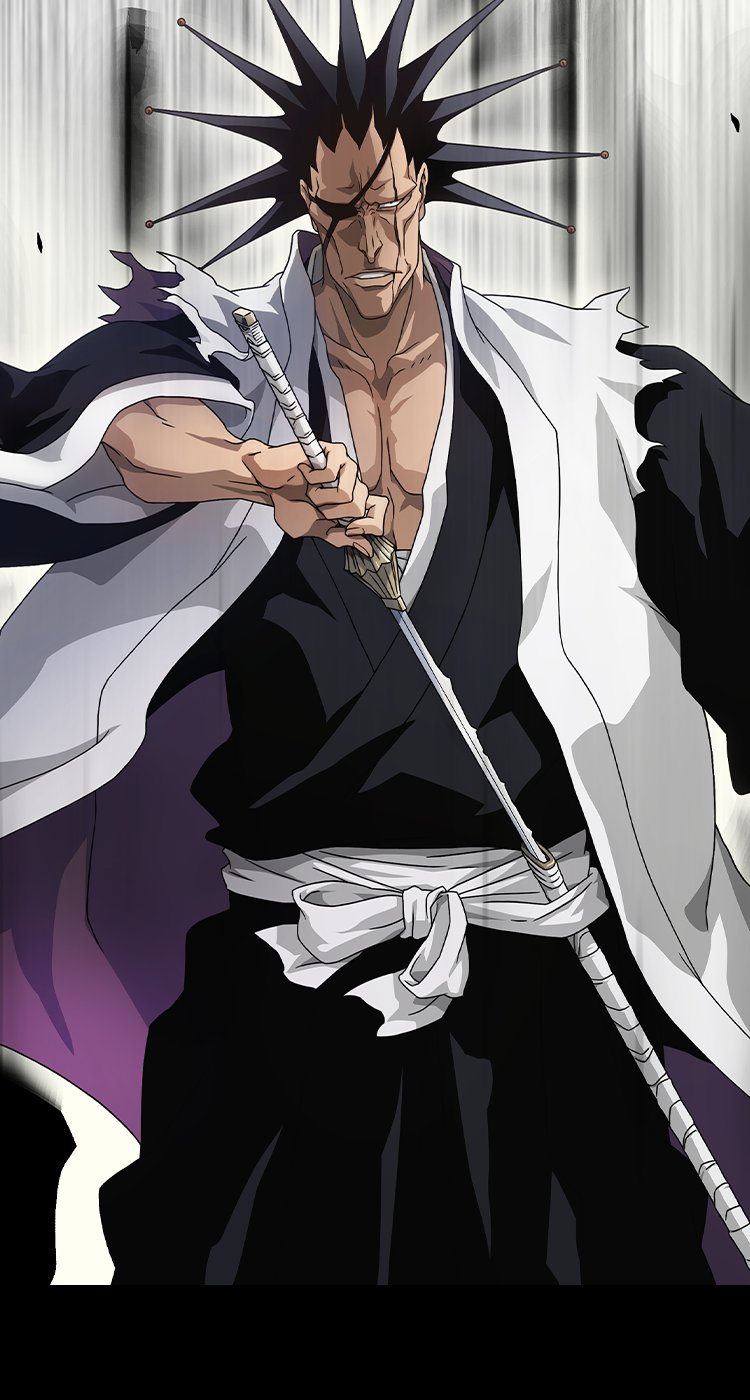
1. Overview
Renji Abarai is the Lieutenant of the 6th Division under Captain Byakuya Kuchiki in the Gotei 13. Born in the poorest district of the Rukongai, Renji clawed his way out of poverty and obscurity through sheer determination, becoming one of the few Soul Reapers to graduate from the Shinigami Academy and rise to the rank of lieutenant within a relatively short period. His journey is defined by his relationship with Rukia Kuchiki, whom he met as a fellow street orphan in the Rukongai. The two formed a bond of survival and mutual support that would shape the rest of their lives. When Rukia was adopted into the Kuchiki noble family, Renji found himself left behind, a gap in social status that ignited his burning desire to become powerful enough to stand beside her as an equal. He enrolled in the Shinigami Academy, graduated with respectable marks, and was assigned to the 11th Division under Kenpachi Zaraki, where he honed his combat skills in the most battle-hungry squad in the Gotei 13. He eventually achieved Bankai, one of the few lieutenants to do so, and transferred to the 6th Division as Byakuya's lieutenant. Throughout the series, Renji struggles with feelings of inadequacy, his desire to protect Rukia, his respect for Byakuya, and his complicated friendship with Ichigo Kurosaki.
2. Appearance
Renji Abarai cuts an imposing figure that stands out even among the distinctive Soul Reapers of the Gotei 13. He is exceptionally tall with a lean, muscular build, and his most immediately recognizable feature is his bright red hair, which he wears styled in a spiky, wild ponytail that extends down his back. His hair is a symbol of his Rukongai origins, a reminder that he is not from a noble family but from the streets. His entire torso and arms are covered in elaborate tattoos, traditional Rukongai markings that cover most of his visible skin beneath his uniform. These tattoos are not decorative but represent his identity as a survivor from the lower districts, a permanent reminder of where he came from and how far he has risen. He has a stern, intense expression with sharp, angled eyebrows that give him a perpetually determined look. Renji wears the standard black shihakusho of the Gotei 13 with the lieutenant's white sleeveless haori over his shoulders. The haori has the 6th Division insignia on the back, representing his position as Byakuya Kuchiki's direct subordinate. His zanpakuto Zabimaru is carried at his waist in its sealed state, appearing as an ordinary katana with a hilt wrapped in white cloth. When released, the blade extends into a segmented, whip-like sword with alternating wide and narrow sections resembling a baboon's tail.
Renji's appearance undergoes significant changes during the Thousand-Year Blood War arc after he trains in the Royal Palace under the Kirinji and his fellow Zero Division members. His new shihakusho becomes more refined, with a white outer garment that has a higher collar and a more streamlined silhouette. His Zabimaru's appearance changes as well, reflecting his true Bankai's nature. The most significant change is in his demeanor: the younger Renji who was brash and eager to prove himself has matured into a calm, confident officer who carries himself with the dignity of someone who has earned his position. In the epilogue set ten years after the war, Renji has grown out his hair even longer and wears a more formal lieutenant's uniform. His tattoos remain visible, a constant reminder of his origins even as he has become a highly respected officer in the Gotei 13. He is shown with a tattoo on his chest that was not visible earlier, suggesting that his body art has expanded alongside his growth as a Soul Reaper.
3. Personality
Renji Abarai is defined by his fierce determination and his uncompromising loyalty to those he cares about. He is brash, loud, and wears his heart on his sleeve, a stark contrast to his captain Byakuya's stoic aristocratic demeanor. Renji's emotions are always close to the surface, and he is quick to anger, quick to laugh, and quick to defend his friends with every ounce of his strength. He does not know how to be subtle or diplomatic, preferring to confront problems head-on with direct action. This straightforwardness sometimes causes him to act impulsively, but it also makes him a reliable ally in the Gotei 13. His loyalty to Rukia Kuchiki is the central driving force of his life. He has loved her since childhood, though his feelings have evolved from childhood affection into a deep, abiding commitment that transcends romance. Everything Renji has achieved, from graduating the Academy to achieving Bankai to becoming a lieutenant, was motivated by his desire to stand beside Rukia as an equal rather than as a charity case from the Rukongai. This drive sometimes manifests as insecurity and jealousy, particularly of Byakuya, whom Renji initially resents for taking Rukia away from him.
Renji's character arc is one of learning to trust his own worth. He begins the series as a man who defines himself by his failures: his failure to protect Rukia from being adopted into the Kuchiki family, his failure to defeat Byakuya in the Soul Society arc, his failure to achieve a complete Bankai on his own. Over time, he learns that strength is not measured solely by victory in battle but by the willingness to stand up again after being knocked down. His friendship with Ichigo Kurosaki is instrumental in this growth. Ichigo and Renji share a parallel journey: both are outsiders who rose through sheer willpower, both have something to prove, and both have a deep connection to Rukia. Their initial rivalry gives way to mutual respect and genuine friendship. Renji is also fiercely proud of his position in the 6th Division and his role as Byakuya's lieutenant. He initially saw Byakuya as an obstacle but came to respect his captain's power and principles, eventually considering it an honor to serve under him. Renji has a playful, competitive side that emerges around his friends, and he enjoys sparring, drinking, and bantering with his fellow Soul Reapers. He has a strong sense of justice and cannot tolerate bullies or those who abuse their power, a value forged by his harsh upbringing in the Rukongai.
4. Abilities & Powers
Renji Abarai is a powerful combat Soul Reaper whose fighting style combines raw physical strength, zanpakuto versatility, and a never-give-up attitude that allows him to push beyond his normal limits. His zanpakuto Zabimaru is a baboon-and-snake type that, in its sealed state, appears as a standard katana. When released with the command "Howl, Zabimaru," the blade transforms into a segmented, whip-like sword consisting of alternating wide and narrow blade sections connected by extendable links. This design allows Zabimaru to function as both a sword and a whip, capable of striking at range, wrapping around opponents, and delivering powerful slashing attacks. The segmented nature of the blade means it can extend to considerable length, and Renji can control the segments independently to some degree. His Shikai abilities include Hikotsu Taiho (Baboon Bone Cannon), where he compresses the blade segments into a single massive blade and fires it at his opponent like a projectile. He can also use the segmented blade to entangle opponents and constrict them, combining the properties of a sword and a serpent.
Renji's Bankai, Soo Zabimaru (Double-Headed Snake Baboon), is a powerful Bankai that has evolved over the course of the series. In its original state, the Bankai manifested as a massive skeletal snake composed of giant interconnected bone segments that covered Renji's arms and extended outward to attack. This form granted tremendous power but was partially incomplete because Renji had not truly mastered the name of his Bankai. After training in the Royal Palace during the Thousand-Year Blood War, Renji achieves the true form of his Bankai. The complete Soo Zabimaru manifests as two massive skeletal serpentine creatures, one representing the baboon and one representing the snake, that wrap around Renji's arms and body. The snake head covers his right arm, and the baboon head covers his left, each capable of independent attack and defense. This true Bankai is far more powerful than the incomplete version, granting Renji increased speed, strength, and the ability to fire devastating energy blasts from the serpentine heads. Renji is also a proficient hand-to-hand combatant, having trained in the 11th Division where close-quarters fighting is emphasized over kido. He possesses above-average spiritual pressure for a lieutenant and has demonstrated the ability to use basic kido, though he prefers direct combat. His endurance is exceptional, allowing him to continue fighting through injuries that would incapacitate lesser Soul Reapers.
5. Story Arcs
Soul Society Arc. Renji is introduced as an antagonist who opposes Ichigo's mission to rescue Rukia. He initially embodies the Gotei 13's authority, confronting Ichigo in the Seireitei and engaging him in a fierce battle. During this fight, Renji reveals his Bankai for the first time and gains the upper hand, but Ichigo's determination to save Rukia pushes him to defeat Renji. The battle leaves Renji injured and reassessing his priorities. When he learns that Rukia's execution is being expedited by Aizen's manipulation, Renji switches sides and helps Ichigo infiltrate the execution ground. His battle against Byakuya is a desperate attempt to prove himself worthy of Rukia's friendship, but he is soundly defeated, his incomplete Bankai no match for Byakuya's Senbonzakura Kageyoshi. This defeat is a turning point for Renji, forcing him to acknowledge the gap between his aspirations and his current abilities and to recommit himself to growing stronger.
Arrancar Arc. Renji accompanies Ichigo and the others to Hueco Mundo to rescue Orihime from Aizen's captivity. He faces the 8th Espada Szayelaporro Granz and is initially overwhelmed by the Espada's hax-type abilities. Szayelaporro uses his Voodoo Doll ability to replicate Renji's internal organs in dolls, then destroys them to incapacitate him. Renji is forced to rely on the assistance of Uryu Ishida to defeat Szayelaporro, as their combined efforts and the unexpected intervention of the newly arrived Mayuri Kurotsuchi turn the tide. This battle highlights Renji's weakness against opponents who use trickery and science-based abilities rather than direct combat. He also fights alongside Ichigo and the other captains in the Fake Karakura Town battle against Aizen's forces, demonstrating his growth as a fighter capable of holding his own against lieutenant-level Arrancars.
Thousand-Year Blood War Arc. The TYBW arc is the pinnacle of Renji's character development. When the Wandenreich invades the Soul Society, Renji is defeated alongside the other lieutenants by the Sternritter, including a humiliating defeat by Mask De Masculine. After being healed by the Zero Division, Renji is transported to the Royal Palace for training. Under the guidance of the Zero Division members, particularly Ouetsu Nimaiya, Renji discovers that his understanding of Zabimaru had been fundamentally flawed. He had never truly learned his zanpakuto's name, instead using a partial Bankai that was missing its true power. After a grueling training session where his body is broken and rebuilt, Renji achieves the true form of Soo Zabimaru. He returns to the Soul Society battlefield and defeats Mask De Masculine in a rematch, demonstrating his newfound power. His true Bankai proves capable of devastating the Sternritter who had previously humiliated him. Renji participates in the final assault on Yhwach's fortress and fights alongside Ichigo and Rukia in the climactic battle. After the war, Renji is promoted to captain-level status regarding raw power, though he remains a lieutenant.
Epilogue. In the epilogue set ten years after the Thousand-Year Blood War, Renji has married Rukia Kuchiki, fulfilling the promise they made to each other as children in the Rukongai. They have a daughter together named Ichika Abarai, who is already showing signs of spiritual awareness. Renji has become a standout officer in the Gotei 13, his tattoos a symbol not of poverty but of the journey from the lowest district to the highest ranks of the Soul Society. He continues to serve under Byakuya, now with complete mutual respect between captain and lieutenant.
6. Relationship Network
The central relationship in Renji's life is with Rukia Kuchiki, whom he met as a fellow orphan in the Rukongai. They formed a survival pact as children, stealing food together and protecting each other from older bullies. When Rukia was adopted by the Kuchiki family, Renji felt abandoned and inadequate, unable to follow her into nobility. This loss drove his entire life's ambition: to become strong enough that the distance between them would not matter. Their relationship evolves from childhood friends to allies, to fellow officers, and finally to husband and wife. Byakuya Kuchiki is initially Renji's rival and object of resentment. Renji views Byakuya as the man who took Rukia away and as a cold aristocrat who cannot understand love. After their battle in the Soul Society arc and Byakuya's subsequent softening toward Rukia, Renji develops deep respect for his captain. The two eventually form an effective partnership based on mutual recognition of each other's skills.
Ichigo Kurosaki begins as Renji's enemy and becomes one of his closest friends. Their first battle in the Soul Society establishes a rivalry based on parallel circumstances: both are fiercely protective of Rukia, both are outsiders fighting against established systems, and both have more raw power than their formal training suggests. As the series progresses, Renji and Ichigo develop a genuine friendship, fighting alongside each other and pushing each other to improve. Renji's respect for Ichigo is demonstrated when he follows him into battle without hesitation. His relationship with the 11th Division, where he served before transferring to the 6th, shaped his combat style. He was personally trained by Ikkaku Madarame, who taught him that fighting is about spirit as much as technique. Renji's relationship with his fellow lieutenants is professional but warm. He has a friendly rivalry with Shuhei Hisagi of the 9th Division and mutual respect with Rangiku Matsumoto of the 10th Division. He is particularly close to Ikkaku Madarame, who remains a close friend and sparring partner. Zabimaru itself has a distinct personality as a zanpakuto spirit, initially appearing as a confrontational and playful entity that delights in testing Renji's worthiness. Their relationship evolves from one of conflict to genuine partnership.
7. Cultural Impact & Popularity
Renji Abarai has established himself as a popular supporting character in the Bleach franchise, consistently ranking in the top ten of official Shonen Jump character popularity polls throughout the series' run. His appeal lies in his relatable underdog story: a boy from the slums who refuses to let his origins define his destiny. Fans identify with his struggles, his insecurities, and his determination to protect the people he loves despite overwhelming odds. His character design, created by Tite Kubo, is among the most distinctive in the series. The combination of bright red hair, full-body tattoos, and a snake-like zanpakuto creates a visual identity that is immediately recognizable. Kubo has stated that Renji was designed to contrast with Byakuya in every way: streetwise versus aristocratic, emotional versus stoic, loud versus quiet. This contrast makes their partnership as captain and lieutenant compelling. Renji's tattoos, which were unusually extensive for a mainstream shonen character at the time of the series' debut, influenced later character designs in the genre. His voice actors have received significant acclaim: Kentaro Ito delivers a passionate, emotionally raw performance in Japanese, while Wataru Takagi's early work and later replacement by Masanori Ikeda added layers of complexity to the character. In English, Wally Wingert's performance captures Renji's brashness and vulnerability equally well.
Renji's character arc, particularly his journey from antagonist to ally to Ichigo's trusted comrade, is frequently cited as a standout redemption arc in shonen manga. Unlike many characters who switch sides instantly, Renji's change of heart is gradual and earned, rooted in his existing loyalty to Rukia and his growing respect for Ichigo. The revelation that his Bankai was incomplete and his journey to the Royal Palace to achieve its true form was a highlight of the Thousand-Year Blood War arc, praised for its emotional payoff after years of speculation about whether Renji had truly mastered his zanpakuto. His marriage to Rukia in the epilogue was an anticipated romantic resolution in the series, generating significant discussion among fans for years before it was confirmed. Renji has appeared in every Bleach video game, typically as a mid-tier fighter with balanced stats and unique Zabimaru-based moves. His Bankai, both the incomplete and complete versions, are featured as ultimate abilities in games like Bleach: Brave Souls and the Bleach: Heat the Soul series. In fan communities, Renji is frequently analyzed as an example of a well-written male supporting character whose entire character arc does not revolve around the protagonist but around his own relationships and goals. His tattoos have become iconic elements of Bleach cosplay, and his straightforward, emotional personality has made him a fan favorite for merchandise, from action figures to apparel.
8. FAQ
What is Renji's Bankai and its true power?
Renji's Bankai is Soo Zabimaru (Double-Headed Snake Baboon). In its original incomplete form, it appeared as a giant skeletal snake. After training in the Royal Palace during the TYBW arc, Renji achieved the true Bankai, which manifests as two massive skeletal serpentine creatures on his arms, one representing the baboon and one representing the snake. This form grants vastly increased power and the ability to fire devastating energy blasts.
Did Renji and Rukia get married?
Yes, Renji and Rukia marry and have a daughter named Ichika Abarai, as shown in the epilogue set ten years after the Thousand-Year Blood War. Their relationship develops throughout the series from childhood friendship in the Rukongai to mutual respect as fellow Soul Reapers, culminating in marriage and a family. This fulfills their childhood promise to stay together.
Why does Renji have tattoos and what do they mean?
Renji's tattoos are traditional Rukongai markings that cover his torso and arms. They are a symbol of his origins in the poorest districts of the Soul Society and represent his identity as a survivor from the streets. Unlike noble families who display their status through crests and formal attire, Renji wears his heritage on his skin as a permanent reminder of how far he has risen.
How did Renji become a Soul Reaper lieutenant?
Renji graduated from the Shinigami Academy, joined the 11th Division under Kenpachi Zaraki, and eventually achieved Bankai, making him one of the few lieutenants capable of Bankai. He transferred to the 6th Division as Byakuya Kuchiki's lieutenant, a position he earned through his combat skill and his close relationship with Rukia rather than through noble connections.
Is Renji strong enough to be a captain?
After achieving his true Bankai in the Thousand-Year Blood War arc, Renji is certainly powerful enough to be a captain. He defeated the Sternritter Mask De Masculine in a rematch and fought alongside the strongest captains in the final battle. However, he chooses to remain a lieutenant, possibly out of loyalty to Byakuya and a desire to honor his position in the 6th Division.