1. Overview
Sosuke Aizen is the primary antagonist of the first half of Tite Kubo's Bleach and a very brilliantly written villains in shonen manga history. He is a former Captain of the 5th Division in the Gotei 13 who masterminded a century-long conspiracy to overthrow the Soul King, reshape reality, and install himself as the new god of the Bleach universe. Aizen is a genius-level intellect whose patience, strategic planning, and mastery of deception allowed him to manipulate virtually every major character in the series for over a hundred years. He orchestrated the creation of the Hogyoku, a wish-granting orb of immense power, by tricking Kisuke Urahara into completing it, then faked his own death to operate from the shadows while building an army of Arrancars in Hueco Mundo. His zanpakuto, Kyoka Suigetsu, is widely considered the most dangerous illusion-type weapon in existence, with the ability to control all five senses of anyone who has witnessed its release. Aizen's philosophy is rooted in an acute sense of loneliness born from his overwhelming genius. From his earliest days in the Soul Reaper academy, Aizen saw the truth behind the Soul Society's carefully constructed order: the Soul King is a powerless puppet maintained by an elaborate system of lies and sacrifices. Aizen sought to tear down this corrupt system and replace it with a new order under his absolute rule. His defeat by Ichigo Kurosaki following his fusion with the Hogyoku led to his imprisonment in the deepest level of Muken, the Soul Society's most secure prison, for a sentence of 20,000 years.
2. Appearance
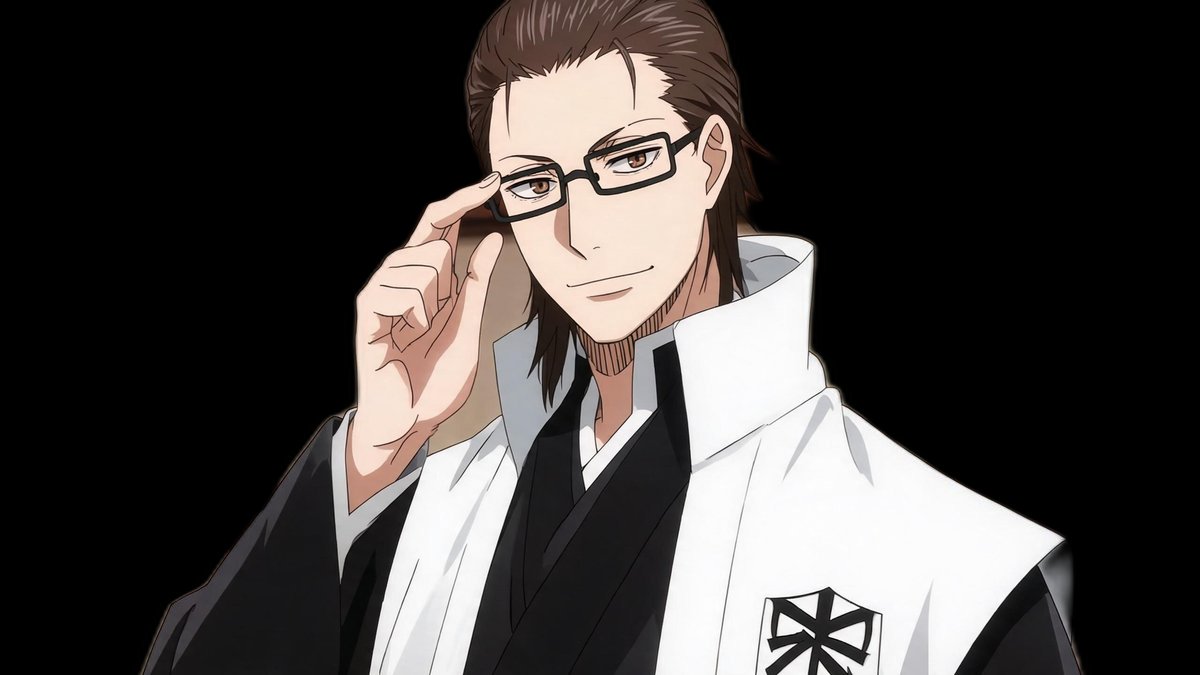
Sosuke Aizen has a strikingly handsome and refined appearance that he deliberately cultivated to project an image of gentleness and approachability during his time as a captain. He has brown hair cut in a neat, styled fashion, brown eyes, and a calm, composed expression that rarely shows emotion. His most defining feature before his betrayal was the pair of round-framed glasses he wore, which made him look like a kind, intellectual scholar rather than a ruthless schemer. After revealing his true nature, Aizen slicks his hair back to appear more aggressive and arrogant, and he removes his glasses, visually signaling his departure from the mask of humility he wore for over a century. Aizen wears the standard white captain's haori over his shihakusho during his tenure in the Gotei 13. After his betrayal, he adopts a white, high-collared outfit befitting his self-appointed role as a transcendent ruler. He keeps his zanpakuto, Kyoka Suigetsu, at his side at all times, sheathed in a white scabbard.
After fusing with the Hogyoku, Aizen undergoes several dramatic physical transformations. In his chrysalis form, he is wrapped in a dark cocoon that later bursts open to reveal his transcendent form: his face is surrounded by a dark, liquid-like substance, his outfit becomes a hybrid of Soul Reaper and Hollow design, and he grows five dark orbs behind him that represent the five aspects of his transcendence. In his ultimate form, his body is partially fused with the Hogyoku itself, with a gaping hole in his chest exposing the glowing orb, and his lower body becomes composed of dark energy tentacles. After his defeat by Ichigo's Final Getsuga Tensho, the Hogyoku rejects Aizen because it recognizes that he no longer desires power above all else. This rejection reverts his body to a heavily bandaged state, bound to a chair in Muken. During the Thousand-Year Blood War arc, Aizen is shown heavily restrained in Muken, still imprisoned in his sealed chair, his body bound by layers of spiritual bands, yet his eyes still glow with the residual power of the Hogyoku, indicating that he has not lost all of his transcendent abilities.
3. Personality
Sosuke Aizen is defined by a terrifying combination of supreme intelligence, infinite patience, and monumental arrogance. He is a master of deception who spent over a century maintaining the perfect facade of a kind, gentle, slightly absent-minded captain. This mask was so convincing that characters who knew him for decades, including his lieutenant Momo Hinamori, who idolized him, and his fellow captains, were completely blindsided by his betrayal. Aizen views himself as a transcendent being who has evolved beyond the limitations of Soul Reapers, Hollows, and humans. His famous speech about the nature of the Soul King reveals his core belief: the Soul Society is built on a foundation of lies, and he alone has the vision and power to tear it down and build something better. He genuinely believes that he is destined to rule, and his arrogance is so absolute that he refuses to acknowledge any being as his equal, including Yhwach, whom he describes as someone who merely inherited power rather than achieving it through his own effort.
Aizen is not purely evil in the sense of enjoying cruelty for its own sake. He is coldly pragmatic and views individuals as either useful tools or obstacles to be eliminated. His treatment of Momo Hinamori, who loved and trusted him unconditionally, is among the most cold-blooded acts in the series, as he repeatedly exploits her trust and nearly kills her without hesitation. Yet Aizen also possesses a twisted form of honor. He acknowledges Ichigo's growth and refuses to underestimate him, treating the young Soul Reaper as a genuine rival worthy of his full attention. He also demonstrates grudging respect for Kisuke Urahara, the only person whose intellect he considers comparable to his own. Aizen's long imprisonment in Muken has not broken his spirit. In the Thousand-Year Blood War, when Shunsui Kyoraku temporarily releases him to fight Yhwach, Aizen demonstrates that his will remains unbroken and his power undiminished. He attacks both Yhwach and the Soul Reapers indiscriminately, loyal only to his own ambitions. His personality is , in the end, a tragedy of genius: a man so far beyond everyone else that he can only find meaning in the pursuit of absolute power.
4. Abilities & Powers
Aizen possesses a combination of natural abilities and acquired powers that make him a very formidable beings in the Bleach universe, even without the Hogyoku. His spiritual pressure is described as utterly overwhelming, capable of paralyzing lesser Soul Reapers and Arrancars simply by being in his presence. This pressure was so immense that even captain-class fighters like Shinji Hirako, who trained for decades to counter Aizen's abilities, could not believe the scale of his power. Aizen is a master of all four Shinigami combat arts: swordsmanship, hand-to-hand combat, kido, and speed. He is particularly exceptional in kido, able to cast high-level spells without incantation and even combine multiple spells in creative ways. During his fight against the assembled captains in Fake Karakura Town, he effortlessly stops Captain-level kido with one hand and counters with his own spells at higher levels. His swordsmanship is refined over centuries of practice, but he rarely relies on it because his illusions make direct combat unnecessary.
Aizen's zanpakuto Kyoka Suigetsu (Mirror Flower, Water Moon) possesses what is arguably the most dangerous ability in the series: complete hypnosis. The Shikai activates by showing the blade's release to an opponent. Once an opponent sees the instant of Kyoka Suigetsu's Shikai release, they fall under its control forever. Aizen can then control all five senses of anyone affected, creating illusions so perfect that victims cannot distinguish them from reality no matter how hard they try. The ability has no known counter: touching the blade, using one's own reiatsu to disrupt it, or knowing it is an illusion does not break the hypnosis. The only known way to avoid Kyoka Suigetsu's effect is to never see its release in the first place, which is why Yhwach's Almighty ability, which sees all possible futures, allowed him to avoid it by choosing a future where he never witnessed the release. Aizen's reveal that he had been using Kyoka Suigetsu on the entire Gotei 13 since before his betrayal, and that the "death" scene he staged was an illusion, is a very iconic twists in anime history.
After fusing with the Hogyoku, the orb created by Kisuke Urahara that grants the desires of those nearby, Aizen achieves a state of transcendence that places him beyond the category of Soul Reaper or Hollow. In this state, he cannot be sensed by beings below his evolutionary level, as demonstrated when even Captain-level Shinigami cannot detect his reiatsu because he exists on a higher plane of spiritual existence. He gains superhuman regeneration, the ability to fire devastating energy blasts, and a form of evolution that adapts to any threat. His chrysalis state and subsequent transformations represent the Hogyoku responding to his desire for ultimate power. After his defeat and imprisonment, Aizen retains residual power from his Hogyoku fusion, which allows him to still exert influence from his sealed prison in Muken. His spiritual pressure remains at a level that requires constant sealing by the combined efforts of multiple captains.
5. Story Arcs
Aizen's presence is felt across the entire Bleach series, but his direct involvement spans five major arcs. In the Soul Society arc, Aizen is initially presented as a kind captain who was tragically murdered by his own vice-captain. His "corpse" is displayed in the 5th Division barracks, and his apparent death becomes the catalyst for much of the Soul Society's internal conflict. The shocking reveal that he faked his death and had been orchestrating events behind the scenes is a very famous plot twists in manga. When Aizen reveals himself, he effortlessly defeats multiple captains, demonstrates his complete hypnosis, and escapes to Hueco Mundo with Gin Ichimaru and Kaname Tosen, taking the Hogyoku with him.
The Arrancar arc is where Aizen operates most openly as the antagonist. He establishes himself in Las Noches, the fortress he creates in Hueco Mundo, and commands an army of Arrancars, Hollows who have removed their masks and gained Soul Reaper-like powers. He sends his Espada to capture Orihime Inoue for her unique rejection abilities, forcing Ichigo and his friends to invade Hueco Mundo. The arc culminates in the Fake Karakura Town battle, where Aizen faces the combined forces of the Gotei 13. He defeats the captains with contemptuous ease and evolves through multiple Hogyoku forms. His defeat comes when Ichigo, having mastered the Final Getsuga Tensho at the cost of his powers, overwhelms Aizen's evolved form. The Hogyoku rejects Aizen because it recognizes that he is no longer pushing for further evolution, and he is sealed by Kisuke Urahara's kido.
The Thousand-Year Blood War arc features Aizen in a reduced but still pivotal role. Having been imprisoned in Muken for years, he is temporarily released by Shunsui Kyoraku, who needs his power to fight Yhwach. Aizen uses Kyoka Suigetsu to create an illusion that confuses Yhwach during the final battle, buying Ichigo a critical opening. His participation in this battle is entirely self-serving: he attacks both Yhwach and the Soul Reapers without discrimination, but his actions nonetheless help Ichigo land the decisive blow. After Yhwach's defeat, Aizen is returned to his prison in Muken, his sentence extended but his spirit unbroken. His final scenes show him seated in his sealed chair, alone in the darkness, still plotting and scheming, proof of the enduring threat he represents.
6. Relationship Network
Aizen's relationships are defined by calculated manipulation rather than genuine emotion, but several key connections reveal different facets of his character. His relationship with Momo Hinamori is arguably the most tragic. As his lieutenant in the 5th Division, Momo idolized and trusted Aizen completely, viewing him as a mentor and older brother figure. Aizen exploited this trust without hesitation, pointing his blade at her, nearly killing her, and using her as a pawn in his schemes. Momo's breakdown upon learning the truth is a very heartbreaking moments in the series, and her inability to fully accept Aizen's betrayal haunts her for the rest of the story. Aizen's relationship with Gin Ichimaru is one of mutual deception. Gin approached Aizen as a loyal subordinate, but was secretly planning to kill him to avenge Rangiku Matsumoto, whose soul fragment was taken by Aizen as part of his Hogyoku experiments. Aizen was fully aware of Gin's intentions and used him as a convenient tool until the moment of betrayal. Gin's failed assassination attempt, where he reveals his true nature and is killed by Aizen, is a masterful subplot of trust and betrayal.
Aizen's relationship with Kaname Tosen is unique in that Tosen genuinely believed in Aizen's vision. Tosen, blinded by his desire for justice in a corrupt world, viewed Aizen as the instrument of necessary revolution. Their partnership ended only with Tosen's death at the hands of his former friend Sajin Komamura. Aizen's view of Kisuke Urahara is marked by grudging respect. Urahara created the Hogyoku, and Aizen acknowledges him as the only person whose intellect rivals his own. Their final confrontation in Fake Karakura Town, where Urahara seals Aizen after his defeat, completes their long-running rivalry. Aizen's relationship with Ichigo Kurosaki is complex: he views Ichigo initially as an interesting experiment, then as a threat, and finally as a worthy adversary. Aizen was aware of Ichigo's existence from the moment of his birth and deliberately orchestrated events that would push Ichigo to grow stronger. He is one of the few characters who refuses to underestimate Ichigo, and in their final battle, he treats Ichigo as a genuine equal. His relationship with Yhwach is one of mutual contempt: Aizen views Yhwach as an unworthy inheritor of power, and Yhwach considers Aizen a dangerous wild card.
7. Cultural Impact & Popularity
Sosuke Aizen is widely regarded as one of the greatest anime villains of all time, frequently ranking alongside Dio Brando from JoJo's Bizarre Adventure, Johan Liebert from Monster, and Griffith from Berserk in discussions of the most iconic antagonists in Japanese media. His famous line, "Since when were you under the impression that I wasn't using Kyoka Suigetsu?" has become a very quoted and parodied moments in anime history, representing the ultimate example of a villain reveal. Aizen's twist was so impactful that it changed how audiences approach mystery and deception in shonen manga. Before Aizen, shonen villains were typically straightforward powerhouses; after Aizen, series began incorporating more complex, layered antagonists with schemes that spanned multiple arcs. Aizen's design evolution, from the bespectacled scholar to the slick-haired god-complex villain to the otherworldly Hogyoku fusion forms, has been extensively analyzed by anime critics as a visual representation of his character arc from hidden manipulator to open tyrant.
Aizen's voice acting has been universally praised. In Japanese, Shou Hayami's performance is masterful, shifting seamlessly from the gentle, kind tone of the fake Aizen to the cold, arrogant, and god-like voice of the true Aizen. In English, Kyle Hebert delivers a performance that captures Aizen's intellectual superiority and calm menace. Aizen has appeared in every Bleach video game and is consistently a very popular characters in cross-over fighting games like Jump Force, where his moveset captures both his kido mastery and his Hogyoku transformations. His theme music, composed by Shirou Sagisu, uses orchestral arrangements that evoke classical tragedy and grandeur, matching his self-perception as a tragic genius. In fan analysis, Aizen is frequently praised for being a villain who actually succeeds in nearly every aspect of his plan before being defeated by a technicality namely the Hogyoku's rejection. His defeat does not diminish his threat level; in the Thousand-Year Blood War, even bound and sealed for years, he is treated as a last-resort weapon by the Gotei 13. Aizen's influence on manga storytelling is lasting, and his character remains a benchmark by which shonen antagonists are measured.
8. FAQ
What does Kyoka Suigetsu do and how can it be countered?
Kyoka Suigetsu has complete hypnosis, controlling all five senses of anyone who has seen its Shikai release. There is no known counter once affected. The only ways to avoid it are to never see the release in the first place or to possess reality-warping abilities like Yhwach's Almighty that can choose futures where one was never exposed.
Did Aizen really care about anyone, or was everyone a pawn?
Aizen does not appear to form genuine emotional attachments. He views others as tools or obstacles. His relationships with Momo Hinamori, Gin Ichimaru, and Kaname Tosen were all calculated for their utility. The only person for whom he shows something resembling respect is Kisuke Urahara, because Urahara's intellect rivals his own.
Is Aizen stronger than Yhwach?
No, Yhwach is explicitly stronger in raw power. However, Aizen's Kyoka Suigetsu is a wild card that even Yhwach had to use his Almighty ability to counter. Aizen's intelligence and experience make him a different kind of threat. Shunsui Kyoraku released Aizen precisely because his illusion abilities could disrupt Yhwach's perfect future vision.
Why does the Hogyoku reject Aizen at the end of their battle?
The Hogyoku grants the desires of those near it. Aizen's desire for power was absolute at the start of his evolution, but during his battle with Ichigo, he began to doubt. When Ichigo demonstrated power that transcended even Aizen's evolved state, Aizen acknowledged Ichigo's superiority, and the Hogyoku rejected him for no longer desiring further evolution.
What happened to Aizen after the Thousand-Year Blood War?
After helping against Yhwach, Aizen was returned to Muken, the deepest level of the Soul Society's prison. His sentence was extended for his actions during the war, including attacking both sides indiscriminately. He remains sealed in his special chair, restrained by multiple layers of spiritual bindings, watched over by the Gotei 13 as a permanent security risk.